
From Awareness to Conversion: Why Most Marketing Communication Fails (And How We Help Brands Fix It)

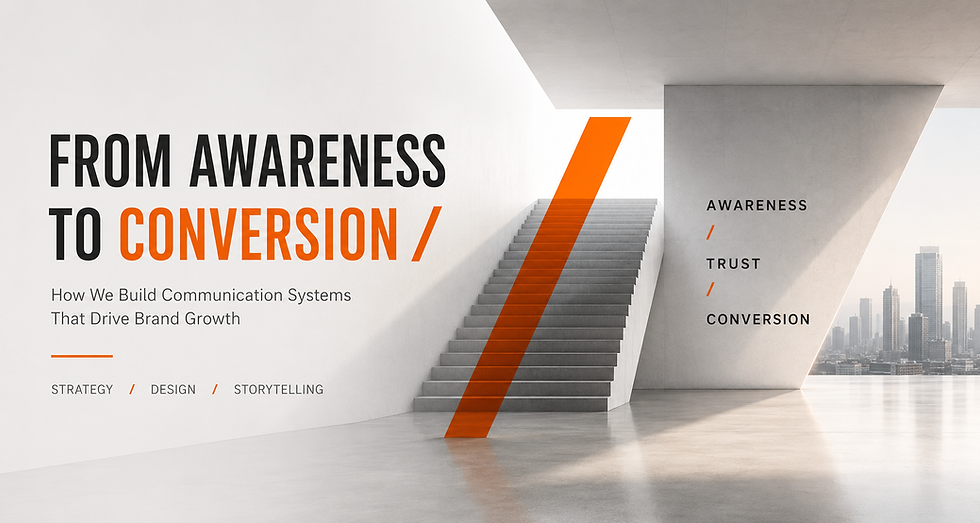
Every week, we speak with business owners, marketing leaders, and founders who are investing heavily in marketing but struggling to see meaningful business outcomes.
The problem is rarely a lack of activity. In fact, most organisations are producing more content, campaigns, and communication assets than ever before. The challenge is that they are often creating the right communication for the wrong stage of the customer journey.
A sales brochure is expected to generate awareness.
A social media post is expected to generate immediate leads.
A website is expected to perform the role of a salesperson.
As a result, communication becomes fragmented, marketing budgets become inefficient, and businesses struggle to build long-term brand equity. More often than not, the root cause is the absence of a clear Brand Communication Strategy. Campaigns, websites, sales tools and marketing assets are developed independently rather than as part of a connected system.
At our Studio, one of the first exercises we undertake during our Creative Retainer Services engagements is categorising communication according to its role in the customer journey. This simple but powerful framework helps businesses move from isolated marketing activities to building a cohesive communication ecosystem and a stronger Marketing Communication Framework.
Before Marketing Begins: Define the Category You Want to Own

One of the most enduring principles in branding comes from the Law of Category:
“If you cannot be first in a category, create a category where you can be first.”
Many organisations position themselves in exactly the same way as their competitors.
“We are a real estate developer.”
“We are a healthcare company.”
“We are a manufacturing business.”
The problem is that customers rarely remember categories. They remember distinct positions. When we work on brand strategy and identity development, the objective is not merely to create a logo or visual system. It is to establish a position that competitors cannot easily replicate.
Our work for brands such as Rare by Kisna, Rivaara Labs, Buma Building Materials, and Equestrian Lifestyle Resort was built around defining a unique market position before communication development began..
A brand that owns a category in the customer’s mind spends less effort competing on price and more effort building preference.
Understanding the Customer Journey

Not every communication asset should be expected to generate sales. Customers move through different stages before making a purchase decision.
One of the simplest ways to understand this journey is through the AIDA framework:
Attention
Interest
Desire
Action
This translates into what marketers commonly refer to as:
TOFU (Top of Funnel)
MOFU (Middle of Funnel)
BOFU (Bottom of Funnel)
Understanding where a customer sits within this journey determines what communication they need from your brand. This process is closely linked to Customer Journey Mapping, helping organisations understand how prospects discover, evaluate and ultimately choose a brand.
When viewed through this lens, communication becomes less about creating individual assets and more about building an Integrated Marketing Communication ecosystem that guides customers from awareness to action.
TOFU: Creating Awareness
At the top of the funnel, the objective is simple:
Get noticed.

Customers cannot engage with a brand they do not know exists.
This is where campaigns, launch communication, social media content, outdoor advertising, public relations and thought leadership play an important role.
For many brands, this is the stage where visibility is built and first impressions are formed.
Our work on projects such as:
NCPA’s “Back on Stage” Campaign
Mumbai Airport Campaign Communication
Mahindra Susten Campaign Design
Narang Vivenda Launch Campaign
Shivam Realty Launch Communication
focused on creating awareness and driving engagement at scale.
These projects demonstrate how strategic communication can help brands cut through clutter and create recall.
MOFU: Building Trust and Preference
Awareness alone does not create customers.

Once prospects know a brand exists, they begin evaluating whether it deserves their trust. This is where many organisations struggle. They invest heavily in visibility but fail to create communication that reinforces credibility.
The middle of the funnel is where websites, brand systems, corporate communication, employer branding, case studies and customer experiences become critical.
Projects such as:
were designed to help businesses communicate their expertise, values and differentiation in a structured manner. For example, a website is not merely a digital brochure. It is often one of the most important trust-building assets within the customer journey.
Similarly, a well-developed brand architecture system creates consistency across every touchpoint, helping customers feel confident in their decision-making process.
Trust is built through consistency, and this is where Brand Experience Design becomes critical. Whether a customer encounters a website, presentation, annual report, social media post or sales brochure, every interaction should reinforce the same perception of the brand.
As a Corporate Branding Agency, we frequently see organisations investing heavily in visibility while underinvesting in the systems that create credibility and preference.
BOFU: Supporting Conversion
At the bottom of the funnel, customers are comparing options and making decisions.

At this stage, communication should remove friction and support action.
Sales brochures, presentations, proposals, sales kits and product catalogues become incredibly important.
These are often some of the most undervalued assets within an organisation because they do not receive the visibility of advertising campaigns.
However, they frequently have the greatest impact on revenue generation.
Projects developed for:
were designed to support sales conversations and help convert interest into action.
When strategically designed, these assets become powerful tools for sales teams and channel partners.
Why Communication Categorisation Matters
One of the most common patterns we observe is communication imbalance.

Businesses produce excessive amounts of conversion-focused communication while neglecting awareness and trust-building activities.
The result is predictable:
Higher customer acquisition costs
Lower engagement rates
Reduced brand recall
Slower sales cycles
This is why every retainer engagement at our Studio begins with understanding how communication is distributed across the customer journey.
We categorise communication into:
Awareness Assets (TOFU)
Designed to create visibility and generate interest.
Trust-Building Assets (MOFU)
Designed to strengthen perception and build preference.
Conversion Assets (BOFU)
Designed to support decision-making and drive action.
Once these categories are mapped, organisations gain clarity on where communication investments should be made and how success should be measured.
Beyond Design Deliverables: Building Communication Ecosystems
The most successful brands do not think in terms of individual campaigns, brochures, websites or social media posts.
They think in terms of systems.

Whether we are developing a launch campaign, designing a website, creating a sales toolkit, building a brand architecture framework, or crafting an environmental branding experience, the objective remains the same: To ensure every communication touchpoint serves a purpose within the broader customer journey.
For organisations seeking sustainable growth, communication should not be approached as a collection of disconnected marketing activities.
It should be approached as an ecosystem.
This is where the role of a modern Branding Agency India has evolved beyond visual design into strategic planning, experience creation and business-focused communication. As a Strategic Design Consultancy, our focus is not merely on creating assets but on designing systems that help brands move audiences from awareness to trust and from trust to action.
Because effective branding is not about creating more communication.
It is about creating the right communication at the right stage of the customer’s decision-making process. The brands that succeed are not necessarily the ones spending the most on marketing. They are the ones aligning Brand Communication Strategy, Customer Journey Mapping, Integrated Marketing Communication, Brand Experience Design and Brand Architecture into a unified business asset. And that is where marketing begins to compound into long-term brand value.

Discover how we help brands build awareness, trust and conversion through strategic branding and communication design:
Visit: www.pavanjava.com


This is such a clear way to diagnose why so much marketing activity doesn’t convert. The examples—a sales brochure for awareness, a social post for leads, a website as salesperson—really highlight how easily we expect one asset to do every job.
Funny how great marketing isn't always about doing more. Like cv editors refine a resume for the right audience, brands succeed when they share the right message at the right moment in the customer journey.