
Engineering Humanity: Conceptualising a 50-Year Legacy Book for TOYO Engineering India

How we approached the narrative, editorial architecture and visual concept for a corporate publication celebrating five decades of engineering, people and purpose.

What Does 50 Years Really Mean for an Engineering Organisation?
A 50-year anniversary is more than a date on a calendar.
For an engineering organisation, five decades represent thousands of decisions, projects, relationships, people,
technological shifts and changing aspirations. It represents knowledge accumulated over generations and an organisation evolving alongside the industries and communities it serves.
But when an organisation reaches a milestone like 50 years, there is a natural temptation to document everything.
Every milestone. Every project. Every achievement. Every year.
And that is precisely where the challenge begins.
Because a corporate legacy publication should not simply answer "What happened?"
It should help the reader understand "What did those 50 years mean?"
That was the thinking behind our conceptualisation of Engineering Humanity: A Decade of Purpose Beyond Projects for TOYO Engineering India—a proposed editorial direction built around the larger idea of engineering, people and purpose.
TOYO Engineering India was established in 1976 and has developed its presence across engineering, procurement, construction and project management assignments in sectors including oil and gas, refineries, petrochemicals, fertilizers, infrastructure and other industrial solutions. Its broader philosophy is rooted in engineering for sustainable growth of the global community.
For a 50-year publication, that depth of history creates an opportunity to tell a story that goes far beyond a conventional corporate anniversary book.
Our role was to explore what that story could become through concept development, narrative flow, editorial thinking and representative mock-page design.
Starting With the Occasion, Not the Pages
When organisations approach a milestone publication, the conversation can quickly move towards practical questions.
How many pages?
What size should the book be?
What paper should be used?
What should the cover look like?
What kind of photography should we commission?
All of these questions matter eventually.
But they are not where the process should begin.
A 50-year corporate publication needs to first establish its reason for existing.
For TOYO Engineering India, the occasion itself provided the starting point.
Five decades offered an opportunity to look backwards at the organisation's journey, but also to examine the ideas and values that connected those years.
That led us to ask a series of questions:
What should readers remember after closing the book?
Should the publication primarily document projects, or explore the impact behind them?
How can five decades of engineering history become an engaging editorial experience?
How can the story remain relevant to employees, leadership, clients, partners and future generations?
And perhaps most importantly:
How can an engineering story become a human story?
These questions shaped the conceptual direction before we began thinking about individual pages.
Understanding the Organisation Beyond Its Projects
Designing a meaningful corporate publication begins with understanding the organisation behind it.
For an engineering company, that means going beyond project lists and capabilities.
Engineering organisations operate within complex ecosystems. Their work connects technology, people, infrastructure, industries, communities and economic development.
TOYO Engineering India's history itself reflects this evolution—from its establishment in India in 1976 to its development as an engineering and project execution organisation working across diverse sectors.
That context mattered to our approach.
If the publication simply presented projects one after another, it could become a visual archive.
But a 50-year anniversary creates the opportunity to examine something deeper:
How has the organisation evolved?
What has remained constant?
What has changed?
Who has shaped that journey?
And what has the organisation's work made possible beyond the project itself?
Understanding these questions allowed us to approach the publication from the perspective of legacy rather than documentation.
The Central Idea: Engineering Humanity
The title Engineering Humanity provided the conceptual anchor.
Engineering is often associated with precision, technology, infrastructure and complex problem-solving.
Humanity introduces another dimension.
It brings in people, communities, relationships, aspirations and impact.
The intersection of these two ideas created a much richer territory for a 50-year publication.
Instead of asking only: What has TOYO Engineering built?
the narrative could ask: What have those engineering capabilities made possible for people and society?
This shift is important.
A conventional anniversary book can celebrate accomplishments.
A legacy publication can explore the meaning behind those accomplishments.
That distinction became central to the conceptualisation.
The projects still mattered. The engineering still mattered. The technical expertise still mattered.
But they became part of a larger story.
A story about people.
A story about progress.
A story about purpose.
Moving From a Timeline to a Narrative
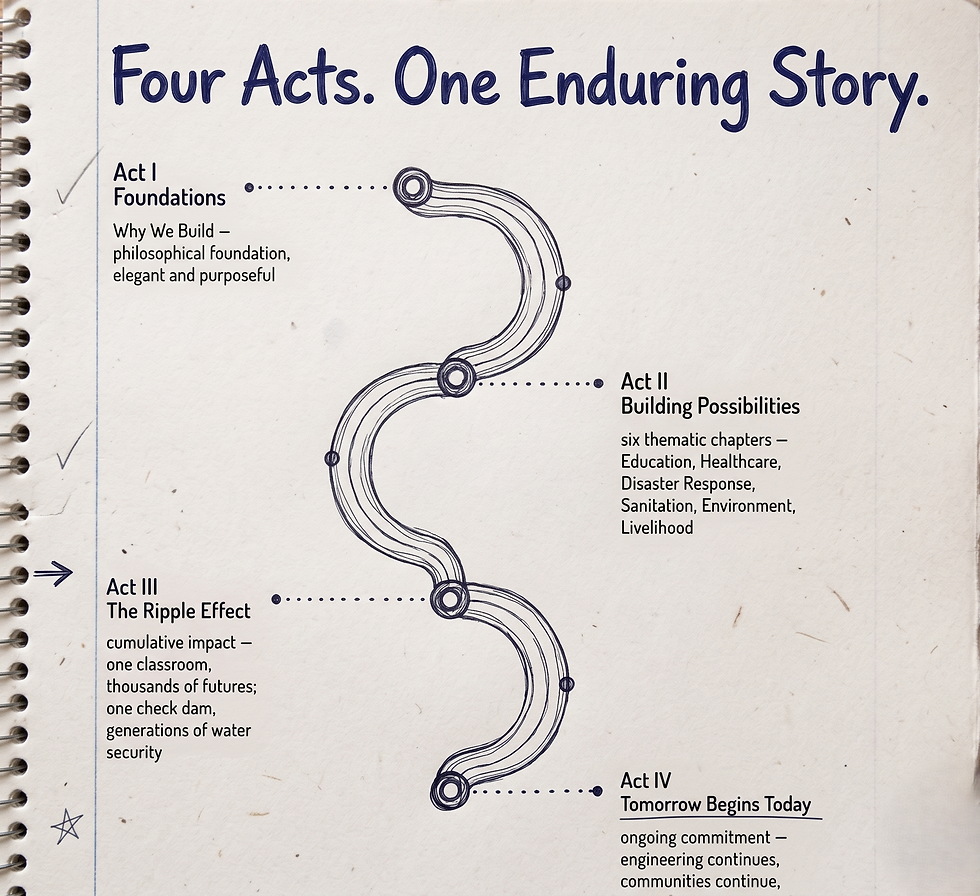
One of the biggest challenges in creating a 50-year corporate book is chronology.
There is an obvious structure available:
1976 → milestone → project → milestone → project → present
It is easy to understand.
But it can also become predictable.
A timeline tells readers when something happened.
A narrative helps them understand why it mattered.
Our approach was therefore to explore a more layered editorial flow.
The journey could move through:
Legacy → Evolution → People → Impact → Purpose → Future
This allows history to remain present without allowing chronology to control the entire book.
The past establishes context.
Evolution demonstrates change.
People bring the organisation to life.
Impact gives achievements meaning.
Purpose connects individual stories.
And the future provides a natural sense of continuation.
The result is a narrative journey rather than a corporate archive.
Building the Editorial Architecture
Once the central idea was established, the next challenge was determining how the different stories could live together.
A 50-year engineering organisation has an enormous amount of material to work with.
There could be:
major projects,
technical achievements,
leadership perspectives,
employee stories,
organisational milestones,
partnerships,
industry developments,
social initiatives,
photographs,
archival material,
data,
and future aspirations.
The answer isn't to give everything equal space.
Editorial architecture is about deciding what deserves attention, when it should appear and how it should connect to what comes next.
We therefore explored the publication as a sequence of experiences rather than a collection of information.
The Legacy
The opening establishes where the journey began and gives the reader a sense of the organisation's foundations.
The Evolution
The narrative then moves through periods of change, showing how the organisation and its capabilities evolved alongside a changing industry.
The People
The story becomes more personal by bringing the people behind the engineering into focus.
The Impact
Projects and initiatives are understood through what they enabled rather than simply what they delivered.
The Purpose
The different stories connect back to a larger organisational philosophy.
The Future
The publication ends not with a full stop, but with the idea of an ongoing journey.
This structure allows a 50-year milestone to become a bridge between history and what comes next.
Why People Had to Be at the Centre

An engineering publication can very easily become dominated by scale.
Large plants.
Industrial environments.
Infrastructure.
Machinery.
Technical drawings.
Aerial photographs.
These visuals communicate capability extremely well.
But capability alone does not communicate humanity.
If the central idea is Engineering Humanity, people have to become part of the visual and editorial narrative.
Engineers.
Employees.
Leadership.
Partners.
Communities.
People whose lives and experiences connect to the organisation's work.
This creates an important visual contrast.
A large industrial image can communicate scale.
A portrait can communicate individuality.
A project photograph can demonstrate complexity.
A human moment can communicate meaning.
The combination creates a richer understanding of the organisation.
The publication therefore becomes less about simply looking at what TOYO Engineering does and more about understanding the people and purpose behind it.
Balancing Engineering Precision With Human Storytelling
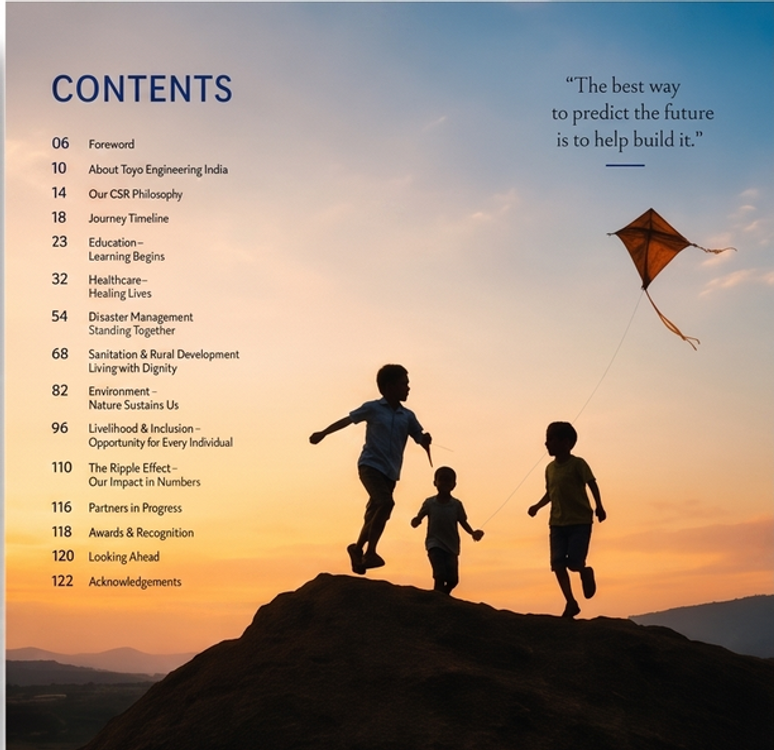
There was another important design challenge.
How do you make an engineering publication feel human without losing the precision and credibility expected from an engineering organisation?
Too much technical information can make the book feel like a corporate report.
Too much emotional storytelling can disconnect it from the organisation's engineering identity.
The design direction needed to occupy the space between the two.
Precision without rigidity.
Emotion without sentimentality.
Information without visual overload.
Luxury without unnecessary decoration.
That balance informed the approach to typography, photography, page hierarchy, visual pacing and information presentation.
The design needed to feel considered and sophisticated while allowing the subject matter to remain the hero.
Designing the Visual Language

Once the narrative direction was established, the visual language needed to support it.
The conceptual approach explored a premium editorial aesthetic rather than the visual conventions of a traditional corporate report.
That meant thinking carefully about:
typography,
scale,
whitespace,
photography,
image sequencing,
chapter openers,
information hierarchy,
timelines,
data visualisation,
pull quotes,
and transitions between different types of content.
A strong corporate publication should not require every page to compete for attention.
Some pages can be information-rich.
Others can be almost entirely visual.
Some moments can slow the reader down.
Others can create momentum.
This variation creates visual rhythm.
And visual rhythm is particularly important in a long-form publication because the reader experiences the book sequentially.
Making Five Decades Feel Like a Journey
Representing 50 years creates an interesting editorial problem.
How do you make the passage of time feel meaningful without turning the publication into a year-by-year catalogue?
The answer lies in identifying moments of transformation.
Instead of giving every year equal importance, the narrative can focus on:
defining periods,
significant transitions,
changes in technology,
shifts in industry,
organisational growth,
important relationships,
and moments that changed the direction of the journey.
This transforms chronology into storytelling.
A decade isn't simply a period of time.
It becomes a chapter in organisational evolution.
That approach allows the reader to understand not only where the organisation came from, but also how it became what it is today.
Making Five Decades Feel Like a Journey

Turning Corporate Information Into Editorial Experiences
A coffee table book is fundamentally different from a report.
A report asks:
What information needs to be communicated?
An editorial publication asks:
How should the reader experience that information?
That distinction influenced how we approached the conceptual pages.
A statistic could become an infographic.
A milestone could become a visual timeline.
A leadership perspective could become a strong editorial opener.
A human story could receive an image-led spread.
A complex project could be introduced through a combination of photography, concise copy and visual sequencing.
The goal is not to decorate information.
The goal is to design the experience of understanding it.
That is where editorial thinking becomes as important as graphic design.
From Narrative Strategy to Mock Pages
Once the concept and narrative direction were established, we translated the thinking into representative mock pages.
These pages served a very specific purpose.
They demonstrated how the broader idea of Engineering Humanity could work as an actual publication.
The mock pages allowed us to explore questions such as:
How should the story open?
How can an engineering project transition into a human story?
How much visual space should a major milestone receive?
How can technical information remain accessible?
How should chapters transition into one another?
How can five decades feel cohesive without becoming repetitive?
The pages were therefore not simply design samples.
They were a way of making the editorial strategy tangible.
The concept could now be experienced through:
composition,
typography,
photography,
page rhythm,
information hierarchy,
and narrative sequencing.
This is an important stage in corporate publication design because it allows the strategic idea to be tested visually before the entire publication is developed.
Designing a Legacy Publication, Not Just an Anniversary Book

There is a subtle but important difference between an anniversary book and a legacy publication.
An anniversary book says:
This is what happened over 50 years.
A legacy publication asks:
What did those 50 years mean?
That difference changes how content is selected.
It changes how stories are sequenced.
It changes how photography is approached.
It changes the role of design.
And ultimately, it changes how the reader experiences the organisation.
A 50-year milestone offers a rare opportunity to step back from day-to-day business communication and see the organisation as a whole.
Its origins.
Its evolution.
Its people.
Its contribution.
Its philosophy.
And its future.
That was the opportunity we saw in conceptualising the TOYO Engineering publication.
What This Project Reinforced About Corporate Coffee Table Book Design
Every corporate publication has its own context, but the thinking behind a strong one remains consistent.
Start with purpose before pages.
Understand the organisation before defining the visual language.
Find the story within the information.
Don't confuse chronology with narrative.
Give people a meaningful place within corporate history.
Use design to control pace, hierarchy and emotion.
Treat the publication as a long-term brand asset.
And perhaps most importantly:
Design should serve the story, not compete with it.
These principles are also at the heart of our broader approach to planning corporate coffee table books—from discovery and editorial architecture to visual development and production thinking.
Beyond Projects, Towards Purpose

A 50-year anniversary gives an organisation an opportunity to look backwards.
But the strongest legacy publications do something more.
They use the past to understand the present.
And they use the present to imagine the future.
For TOYO Engineering, the conceptual territory of Engineering Humanity created a way to look at five decades not simply as a collection of projects, but as a journey shaped by people, engineering, relationships, progress and purpose.
For us, that is what strategic corporate publication design should achieve.
It should not simply make information beautiful.
It should discover the story within the information—and then create an experience around it.
Because the most meaningful corporate books don't simply tell people what an organisation has done.
They help people understand why it matters.
A Legacy Worth Designing

At Pavan Java Studio, we believe a corporate coffee table book should begin with a question, not a layout.
What is the story worth preserving?
For milestone publications, that question becomes even more important.
Because when an organisation reaches 50 years, it has accumulated far more than achievements. It has accumulated experiences, relationships, knowledge, people and purpose.
Our role is to bring those elements together into an editorial experience that feels worthy of the legacy it represents.
Because five decades deserve more than a timeline. They deserve a story.
Frequently Asked Questions
What is a 50-year corporate coffee table book?
A 50-year corporate coffee table book is a premium publication created to document and interpret five decades of an organisation's history, achievements, people, values and evolution through editorial storytelling and visual design. Unlike a conventional corporate report, it is designed to create a lasting and engaging representation of organisational legacy.
How do you plan a 50th anniversary corporate book?
Planning should begin with the purpose of the publication, its intended audiences and the story the organisation wants to leave behind. The process can then move into content discovery, narrative architecture, editorial planning, visual direction, design development and production.
What should be included in a 50-year anniversary book?
Depending on the organisation and purpose, a 50-year anniversary book can include company history, major milestones, projects, leadership perspectives, employee stories, industry evolution, partnerships, social impact, photography, archival material, timelines and future aspirations.
How can an engineering company tell its story through a coffee table book?
An engineering company can combine its technical achievements with human stories, project narratives, organisational milestones, photography, data visualisation and its broader contribution to society. The key is to create a narrative that connects engineering capabilities with the people and purpose behind them.
What is the difference between a corporate history book and a coffee table book?
A corporate history book may focus primarily on documenting events and chronology. A coffee table book combines historical and corporate content with editorial storytelling, photography and premium visual design to create a more immersive experience.
Why is storytelling important in a corporate anniversary publication?
Storytelling helps readers connect individual achievements and milestones to a larger organisational narrative. It transforms information from a collection of facts into something that communicates culture, purpose, evolution and impact.
How can a corporate coffee table book balance company history with human stories?
A strong editorial structure can alternate between organisational milestones, projects, people, leadership perspectives and impact stories. This creates visual and emotional variety while keeping the publication connected to the organisation's larger narrative.
How does a design agency approach a corporate legacy book?
A strategic design agency begins by understanding the organisation, occasion, audience and communication objectives. It then develops the central concept, narrative architecture and visual language before translating those decisions into page-level design and production systems.
Comments